
By Johnson Dairo Daniel 08032229630
BoldNEWS Africa
Ogun State
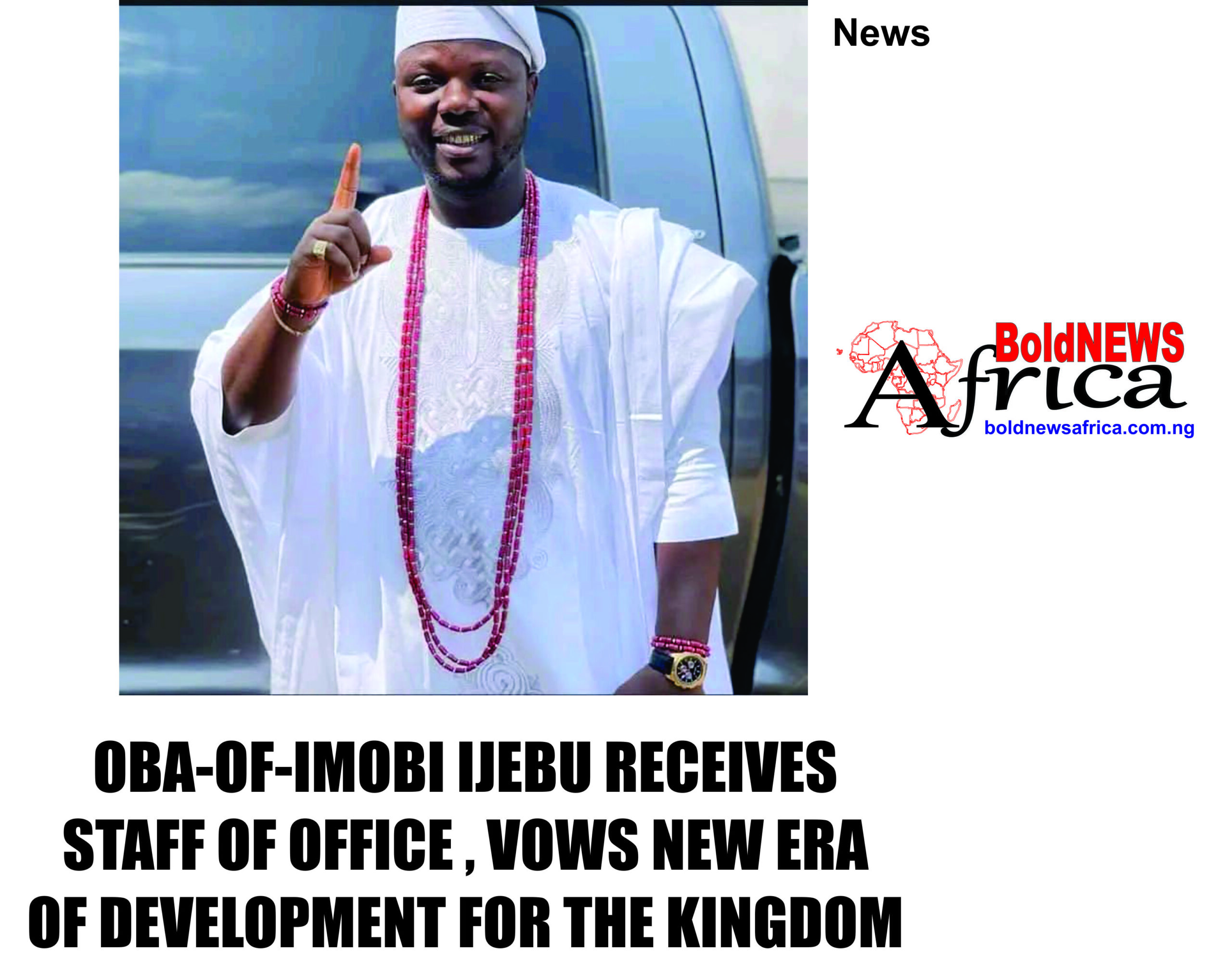
After years of uncertainty, contestation and traditional consultations, a new chapter has opened in the history of Imobi Ijebu, Ogun State, with the installation and formal recognition of Oba Fatai Olatunji Balogun Olufemiloba Oyeyemi Kolawolu Gbadewolu (Agbon Osiyoruwa 1) the Alaye of Imobi as the monarch of Imobi Kingdom
The development reached a major milestone with the presentation of the Staff of Office by the Ogun State Government, formally affirming his position as the traditional ruler of the Imobi Kingdom.
Speaking with journalists at his palace, the Alaye of Imobi described his emergence as an act of divine providence, recalling that the journey, which began several years ago, was marked by challenges, controversies and uncertainty before eventually ending in triumph.
He said he initially hesitated when he was approached to contest for the traditional stool, believing he was not yet prepared for the enormous responsibility that came with becoming a monarch.
“At first, when I was called to become the king, I said I was not ready yet. But when I discussed it with my mother, father, wife and family, they all supported me and encouraged me to go for it,” he said.
According to the monarch, he eventually accepted the responsibility and embarked on what became a long and demanding journey towards the throne.
He expressed gratitude to God for giving him the wisdom, knowledge and strength to overcome the challenges, stressing that his installation should not be seen as the end of a struggle but as the beginning of a greater responsibility to the people.
Oba Fatai Olatunji Balogun Olufemiloba Oyeyemi Kolawolu Gbadewolu said the quest for a recognised traditional ruler for Imobi had existed for decades and could be traced to the efforts of previous generations.
He explained that his late father was among the community elders who had worked towards establishing an appropriate traditional institution for Imobi, noting that several aspirants had previously contested for the stool without the process producing a conclusive outcome.
Oba Fatai Olatunji however, credited Oba Babatunde Ola Ogunlaja, the Aladesonyin Of Odonoforija, Lagos State whom he described as a father figure, with playing a decisive role in his emergence.
According to him, the traditional ruler stood firmly behind him throughout the process and provided guidance at critical moments.
Oba Olufemiloye Oyeyemi Kolawolu, tha (Agbon Osiyoruwa 1) said his recognition followed the established traditional process under the authority of the Awujale and Paramount Ruler of Ijebuland and the Ijebu Traditional Council.
He explained that one of the key issues considered during the process was whether the traditional institution should be restricted to Okemobi or extended to encompass the wider Imobi community.
The newly installed Oba of Imobi said ,the kingdom known to Imobi consists of three principal areas Okemobi, Okemakonluwako and the Oke areas and the traditional authorities eventually resolved that the community required a central traditional institution capable of administering and uniting the entire Imobi Kingdom.
He recalled that even before the passing of the late Awujale of Ijebuland, the traditional authorities had recognised the need for a central institution that could unite the communities and provide a stronger platform for development.
As part of the process, a five-member committee of traditional rulers was constituted to consult with the communities, assess the various areas and conduct the necessary investigations before making its recommendation.
Oba Imobi said the committee visited the various communities across Imobi, with the consultations taking place amid considerable tension and security concerns in some areas. Despite the challenges, he said the process was eventually concluded peacefully.
He described the outcome of the consultations across the 21 villages as one of the defining moments of the process.
According to him, 18 villages supported his candidacy, two villages supported his principal contender, while one village produced a tie, the outcome was subsequently submitted to the appropriate traditional authorities for consideration.
Following the approval of his candidacy at the traditional level, the process proceeded to the Ogun State Government for the necessary administrative and legal procedures.
The long journey eventually reached a major milestone on July 13, 2026, when the Ogun State Government, under the leadership of Governor Prince Dapo Abiodun, approved his appointment alongside other traditional rulers in Ijebuland.
The monarch expressed appreciation to the governor for the approval, describing it as a significant development for the administration, unity and future development of Imobi.
He also commended the traditional institution in Ijebuland for providing guidance throughout the process.
With the traditional process now completed and his position formally recognised by the state government, the Kabiyesi said his attention had shifted from the struggle for the throne to the more demanding task of delivering development to his people.
He said his priority would be to transform Imobi into a community capable of attracting investment, creating employment and opening new economic opportunities for its people.
The widely travel businessman-turned-monarch said he intends to deploy his business experience, international exposure and network to attract investors and development partners to the kingdom.
He said his vision encompasses infrastructure development, economic expansion, tourism, transportation and opportunities that would make Imobi indigenes at home and in the diaspora proud of their ancestral community.
Among his most ambitious ideas is the development of a private port and ferry terminal around the Imute/Ibute axis, which he believes could open a new economic corridor for Imobi and its neighbouring communities.
The new Kabiyesi said his exposure to business and investment had given him an understanding of how private capital could be mobilised to support development through appropriate government licensing, regulation and partnerships.
His vision, he explained, is to attract investors capable of developing water transportation infrastructure, including a ferry terminal and other port-related facilities.
He believes such infrastructure could reduce travel time between coastal communities and Lagos while stimulating trade, tourism, transportation and other commercial activities.
The monarch also linked the proposal to emerging developments across Ogun State’s coastal and waterside communities, stressing that Imobi must position itself to take advantage of the economic opportunities that could arise from the region’s growing connectivity.
Despite his ascension to the traditional throne, Oba Fatai said he would not abandon his business interests. Rather, he said his business experience would complement his responsibilities as a traditional ruler.
He pledged to work with traditional institutions, government, community leaders, indigenes at home and abroad, investors and other stakeholders to advance the fortunes of Imobi.
For him, the Staff of Office is therefore more than a symbol of royal authority; it represents a mandate to serve, unite and develop the people.
The New Face of Imobi may have brought the long search for a central traditional authority in Imobi to a close. But it also marks the beginning of a new contest not for the throne, but for the transformation of royal promises into tangible progress for the people of Imobi.
BoldNEWS Africa
About the Author